Bearberry Leaf (Arctostaphylos uva-ursi): Nature’s Urinary Antiseptic
Bearberry — Arctostaphylos uva-ursi — is one of the most clinically specific herbs in the Western materia medica. Where many herbs have broad, multi-system applications, Bearberry Leaf has a single primary application that is particularly well evidenced: the treatment and prevention of lower urinary tract infections. Its arbutin content — which metabolises in the alkaline urine into hydroquinone, a potent urinary antiseptic — provides a mechanism so specific and well documented that Bearberry Leaf occupies an almost pharmaceutical-like role in herbal urinary tract medicine.
At Herba Naturalle, Bearberry Leaf is included in the comprehensive herb index and is referenced alongside the urinary support formulations in the clinic’s product range — particularly the Cornsilk Plus and Couch Grass Complex, which address complementary dimensions of urinary tract health.
Botanical Identity
Arctostaphylos uva-ursi is an evergreen trailing shrub of the Ericaceae (heather) family, native to mountainous regions of Europe, North America, and Asia. Its small, leathery, oval leaves, tiny pink-white bell-shaped flowers, and distinctive red berries make it easily recognisable. In Latin, uva-ursi means “bear’s grape” — a reflection of bears’ known fondness for the berries. The leaves are the medicinal part, harvested throughout the growing season.
Active Compounds and Mechanism of Action
The mechanism of Bearberry Leaf’s urinary antiseptic action is unusually specific and well understood:
- Arbutin (8–15% of dried leaf) — a hydroquinone glycoside that is absorbed from the digestive system and excreted by the kidneys into the urine. In alkaline urine (pH above 8), arbutin is hydrolysed by urinary bacteria into hydroquinone — a compound with potent antiseptic and bacteriostatic activity against urinary pathogens including E. coli, Proteus, Pseudomonas, and Staphylococcus
- Methyl-arbutin — a related compound with similar conversion and action
- Tannins — gallotannins and ellagitannins providing astringent action on the urinary mucosa, reducing irritation and inflammation
- Ursolic acid — a triterpene with anti-inflammatory and antimicrobial properties
- Flavonoids — quercetin and myricetin derivatives; antioxidant and anti-inflammatory
Clinical Evidence
Multiple clinical trials and meta-analyses have validated Bearberry Leaf for urinary tract infections. A randomised placebo-controlled trial found significant reductions in recurrent UTI incidence in women taking standardised Bearberry extract. German Commission E has approved Bearberry Leaf for the treatment of inflammatory conditions of the lower urinary tract. The mechanism — urinary antiseptic action — is well understood and mechanistically sound.
Clinical Applications
Acute cystitis (uncomplicated): Bearberry Leaf is a first-line herbal option for lower urinary tract infections — the burning, frequency, and urgency that characterise cystitis. For mild-to-moderate uncomplicated cystitis in otherwise healthy adults, it provides a genuine alternative to antibiotics and may be preferred where antibiotic resistance is a concern or where the patient wishes to avoid antibiotics for a mild infection.
Recurrent UTI prevention: Used in maintenance doses between acute episodes, Bearberry Leaf reduces the frequency of recurrent UTIs in susceptible individuals.
Urethritis: The antiseptic and astringent actions are relevant in urethral inflammation.
Cystitis with blood: The haemostatic tannin content adds value in cystitis with mild haematuria (blood in urine).
Important Usage Considerations
Alkaline urine is essential: The antiseptic hydroquinone is only released in alkaline urine. To alkalinise urine, use Bearberry Leaf alongside:
- Sodium bicarbonate (one teaspoon in water before doses)
- Large amounts of alkaline-forming foods (vegetables, fruits)
- Cranberry juice alone does NOT alkalinise urine — it acidifies it, counteracting Bearberry’s mechanism
Short-term use only: Bearberry Leaf should not be used for more than 5–7 days at a time due to the potential for hydroquinone toxicity with prolonged use. Limit to four treatment courses per year.
- Tincture (1:3): 3–5ml three times daily for 5–7 days
- Tea: 3g dried leaf steeped 15 minutes, 2–3 cups daily; best as cold-water maceration for 12 hours to reduce tannin content
Safety
- Pregnancy and breastfeeding: Contraindicated
- Kidney disease: Avoid — hydroquinone may be harmful to damaged kidneys
- Children under 12: Not recommended
- Duration: Maximum 7 days per course; maximum 4 courses per year
- Note: Urine may turn greenish-brown — this is harmless
Explore complementary urinary herbal support in the Cornsilk Plus and Couch Grass Complex from Herba Naturalle. Contact the clinic for personalised advice. Browse the full herb index and all products.
This article is for informational purposes only. If you have symptoms of a urinary tract infection, please see your GP — particularly if symptoms are severe, involve fever, or affect the kidneys.
Our Trending Products & Bundles
-
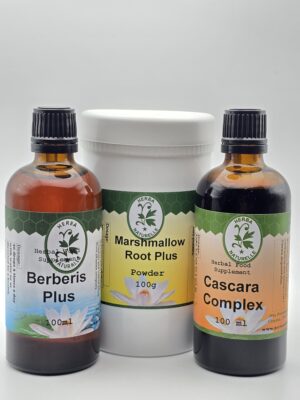 Digestive reset bundle
Original price was: £151.65.£144.95Current price is: £144.95.
Digestive reset bundle
Original price was: £151.65.£144.95Current price is: £144.95.
-
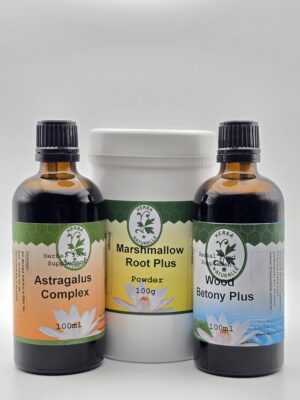 Smooth muscle and immune reset Bundle
Original price was: £177.60.£159.95Current price is: £159.95.
Smooth muscle and immune reset Bundle
Original price was: £177.60.£159.95Current price is: £159.95.
-
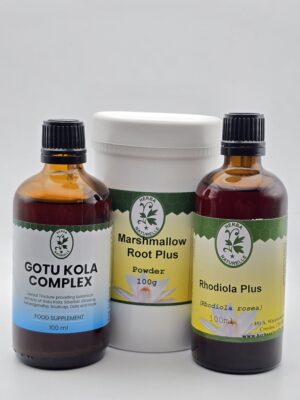 Nervous System Reset
Original price was: £163.68.£149.95Current price is: £149.95.
Nervous System Reset
Original price was: £163.68.£149.95Current price is: £149.95.
-
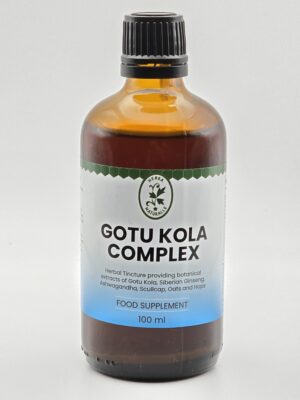 Gotu Kola Complex
£26.95
Gotu Kola Complex
£26.95